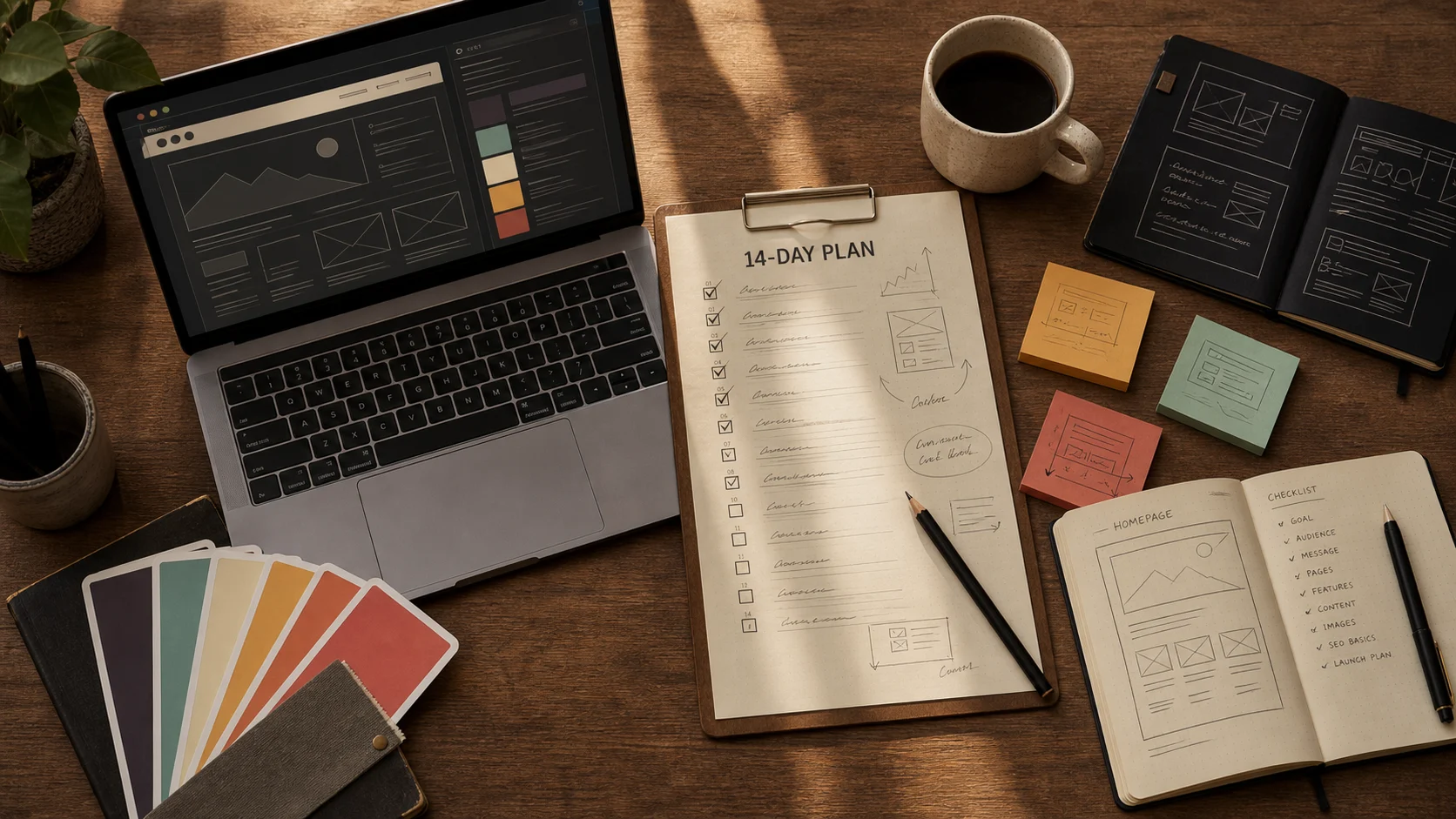
Let me kill a myth before we start: you do not need to show up to a website project with all the answers. If you had all the answers, you would not need help. You would just build the thing.
But here is the flip side. There is exactly one question you cannot outsource, cannot delegate, and cannot figure out later: what do you want this site to do?
Everything else can be pulled out of you in fourteen days. Your audience, your message, your pages, even your taste. A good process extracts most of that, and honestly, it is kind of fun watching people realize they knew more than they thought. But the goal? That one is yours.
So here is how the fourteen days actually go, and what is on you versus what gets figured out together.
Days 1-2: The one question that is actually yours
"I need a new website" is not a goal. It is a symptom. Something is not working, and a website feels like the fix.
Dig one layer down. What is the actual problem? Phone not ringing? Referrals check out your site and then ghost? You are doing great work but look like a hobby online? Booked solid but with the wrong kind of clients?
Turn that into one job for the site. One. Book more calls. Sell the thing. Build the list. Make referrals stop hesitating. Pick the single most important one, because a site that tries to do five jobs does zero jobs well.
Put a number on it if you can. "Fifteen inquiries a month" beats "more business" because six weeks from now, when someone asks whether the homepage should lead with your story or your services, the number answers the question. Taste does not have to.
Can you not land on the number? No problem. But you do have to land on the job. That is the price of admission. Everything after this, we have got you.
Days 3-4: Your customer knows more than you think
This is where people freeze up. "I do not have personas. I do not have data. I have never done a survey."
You do not need any of that to start. You have something better: actual conversations with actual customers. You just need someone to ask you the right questions.
Who is the best customer you have ever had? Who was nervous before they hired you? What did they misunderstand? What finally made them say yes? What did they already try before they came to you?
You are not expected to write your own copy from a blank page. Gosh no. Most of the best material is already hiding in your sales calls, reviews, emails, photos, before-and-afters, and the little phrases customers repeat back to you.
Days 5-7: The pages stop being mysterious
Once the goal and customer are clear, the page plan becomes much less dramatic. Most websites do not need twenty pages. They need the right handful of pages to do genuinely different jobs.
Home gives people the shape of the business. Services explain what is offered and who it is for. About creates trust without turning into a memoir. Work or proof makes the promise believable. Contact removes the friction from the next step.
This is where SEO also gets practical. We map the phrases people actually search, the questions they ask, and the locations or service categories that deserve their own page. It should feel like a clear path through the business, not a keyword attic.
Days 8-9: Proof, taste, and the fear of being obvious
The fastest way to make a site better is usually not to make it cleverer. It is to make it more believable.
That means testimonials, screenshots, project notes, photos, guarantees, process details, pricing guidance, timelines, and little signals that prove a real person is behind the offer. Obvious is not boring when obvious is what the visitor needs to feel safe.
Taste matters too, but it works best when it has a job. The mood should support the offer. The color, typography, imagery, and rhythm should make the business easier to trust, remember, and choose.
Days 10-11: The boring stuff is the launch plan
This is the part nobody wants to think about until it blocks the launch: domains, logins, forms, calendar links, email addresses, analytics, old hosting accounts, DNS, payment links, and the person who still has the password from 2019.
Gather it early. A beautiful website can be stopped by an old Yahoo account faster than by a bad headline.
This is also where we connect the real software: contact forms, email tools, booking calendars, payment platforms, search tools, and any simple automation the site needs to do its job.
Days 12-13: Review without committee fog
Good review is focused. Bad review turns into a committee approving beige.
The question is not "do I like every single thing?" The question is "does this page do the job we chose?" If something feels off, we trace it back to the goal, the customer, the offer, or the next step.
Your gut matters. It just needs to be translated into useful feedback: too formal, not clear enough, missing proof, wrong emphasis, too much friction, not enough confidence.
Day 14: Done means usable
A finished website is not a museum piece. It is a tool people can use.
Done means the pages work on mobile, the forms send where they should, the calls to action are clear, the basic SEO is in place, the launch checklist is complete, and you know what happens after the site goes live.
That is the whole point of the fourteen-day plan. Not rushing. Not skipping the thinking. Just putting the right decisions in the right order so the site can actually launch.